I turned my annual retro and planning into a conversation with AI
How turning my yearly retrospective into a conversation helped me surface blind spots and think more clearly about my goals
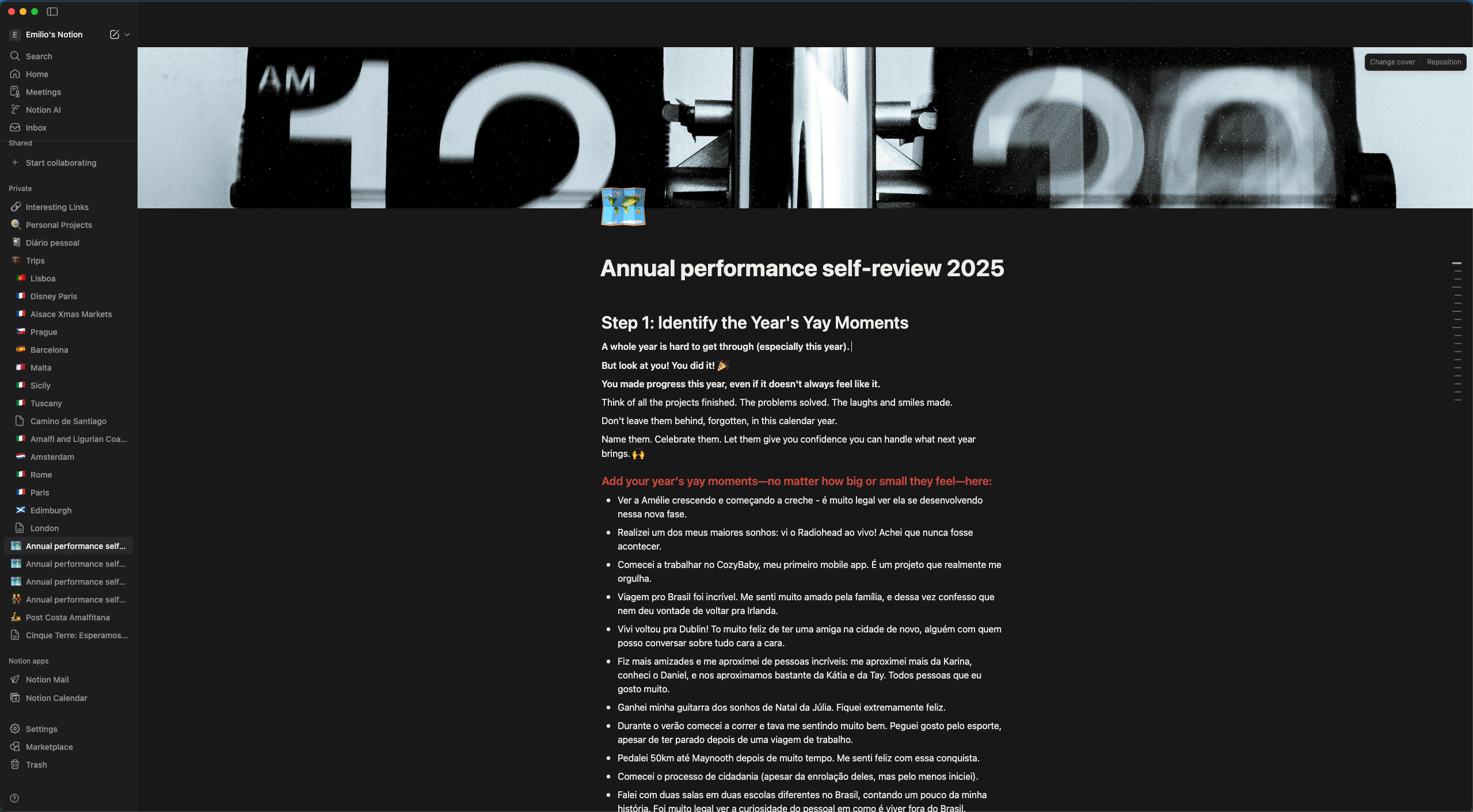
Every December, I do a full retrospective of the year while also planning the next one. I find this incredibly important to stay aware of where things are heading and to start the new year with a clearer perspective on what I actually need to do to achieve my goals.
For the past few years, I've been following a template I found somewhere on the Internet, and it's been extremely helpful. It has questions about how the previous year went, what I learned, and a section dedicated to setting objectives for the next year.
In previous years I wrote everything myself, trying to keep the points clear and concise, listing the objectives and thinking about all the actions needed to reach my goals, all on my own.
A Different Approach
This year, I decided to try something different. I used Claude, connected to Notion via an MCP server, to turn my yearly retrospective into a conversation instead of a "form". Rather than going question by question and writing carefully structured answers, the AI acted as an interviewer. It asked me questions, I replied in natural language without worrying too much about wording, and it continuously updated my 2025 retrospective page in Notion before moving on to the next topic.
The same approach worked for objectives. The AI first asked me what my goals for the year were. Then, one by one, we discussed the steps needed to achieve each goal, checked for blind spots, and organized everything neatly into a new Notion page. I wasn't asking it to "generate a plan" — I was thinking out loud, and it was helping me structure, challenge, and refine that thinking.
Surfacing Blind Spots
For example, when I mentioned needing a dedicated workspace at home for personal projects, it stopped and pointed out how foundational that would be for several of my other objectives. It suggested elevating it from an action point to a full objective of its own — something I probably wouldn't have prioritized properly if I'd been filling out a static form.
It also pushed back when I listed my objectives for the year. I had objectives across ten different areas of my life, and it pointed out that spreading myself that thin would likely lead to the same pattern I'd experienced in previous years: leaving objectives behind and feeling overwhelmed. It suggested I either consolidate or explicitly prioritize a smaller set to focus on first. That kind of pattern recognition — connecting what I was planning to what had actually happened in past years — was exactly the kind of thinking partner I needed.
Once we'd worked through all my objectives, I was left with a long list of tasks that needed to get into Todoist. I solved that with JSON imports this time, asking Claude to generate them based on the Notion page. That worked well, but the experience made me realize I could automate this step entirely — so I built a Todoist MCP to close that gap for next time. More on that in a separate post.
Final Thoughts
Overall, my experience using AI for retrospectives and yearly planning has been very positive. It saved me a lot of time and surfaced insights that made my goals feel more achievable. More importantly, it changed how I used AI: not as a generator, but as an interviewer and editor that helped me think more clearly.